

IICA promote high-level dialogue between agriculture and the environment
Identify synergies and build concrete actions between agriculture and the environment to meet the challenges of adaptation and mitigation of climate change, was what allowed high-level dialogue organized by the Inter-American Institute for Cooperation on Agriculture (IICA) together with the Center for International Forestry Research (CIFOR).
The event took place during the twenty-first Conference of the Parties (cop21) of the UN Framework Convention on Climate Change (UNFCCC), which took place from November 30 to December 11 in Paris, France.
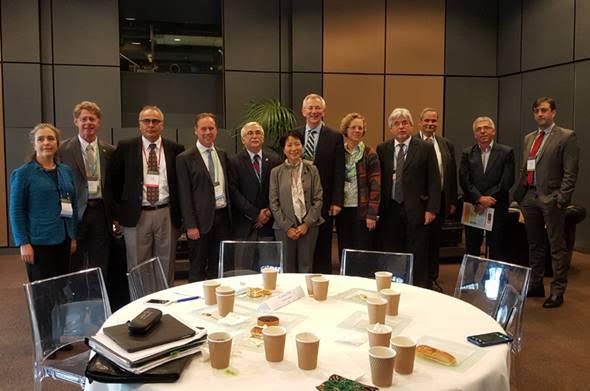
In the space of dialogue agriculture ministers of Costa Rica, Guatemala and Uruguay, and the deputy ministers of Belize, Panama and Paraguay, Minister of Planning Nicaragua, Nicaragua’s ambassador in France, and ombudsmen CIFOR participated Department U.S. state, and the United Nations Economic Commission for Latin America and the Caribbean (ECLAC).
It was also attended by the Executive Secretariat of the Central American Agricultural Council (SECAC), and the Executive Secretariat of the Central American Commission on Environment and Development (SECCAD)
The dialogue was a purposeful exchange of ideas, and exemplified the growing role of agriculture in international climate change negotiations. Ministers discussed how to achieve intersectoral coordination, joint efforts in certain national Contributions (INDC), and generate institutional and regulatory frameworks to address climate change while the development goals of the region is achieved.

“We must make an intersectoral activity and discuss broad and deep the juncture between agriculture and the environment. The international commitment to reduce the emissions intensity of greenhouse gas emissions from the agricultural sector should be done according to the possibilities of food production in each country, and that in turn allows the development of national economies, “he said Minister of Agriculture of Uruguay, Tabaré Aguerre.
Some of the agriculture ministers exchanged ideas during the ministerial purposeful dialogue.
It coincided with the specialist SECAC, Manuel Jimenez, who reaffirmed that efforts must be redoubled, because it is undeniable that climate change is no longer an expectation and its effects are already apparent in the region intensified climate variability.
“The El Nino” laboratory recognized as what lies ahead with climate change, is showing and comparing with what happened in 1997-1998. In the first months of the presence of the phenomenon, the World Food Programme reported 3.3 million people affected and 1.6 million provided food and nutrition insecurity in a partial analysis for four of the eight countries of the Central American Integration System (SICA) “Jimenez said.
High-level Roundtable
In addition, as part of the activities parallel to the cop21, IICA and CIFOR organized a ministerial round table, where Latin American ministers could discuss the challenges they face in their countries with influential global level on the issue of the cooperation and financing on climate change and environment.
In this high-level dialogue was the executive director of the Fund for the Global Environment Facility (GEF), Naoko Ishii; Executive Director of United Nations Environment Programme (UNEP), Achim Steiner; senior director of Environment and Natural Resources of the World Bank, Paula Caballero; CEO and president of World Resources Institute (WRI, for its acronym in English), Andrew Steer; among others.
“Our intervention in the cop21 was positive. IICA, on behalf of its member countries, has been creating opportunities to raise the profile of the sector in global discussions, emphasizing the contribution that agriculture can make in Latin America, reducing emissions and making more efficient and responsible use of resources natural, which means better diversified agriculture, resilient and adapted to future climate conditions, “he concluded lead specialist Resilience and Integrated Risk Management in Agriculture IICA, David Williams.
Source: IICA