

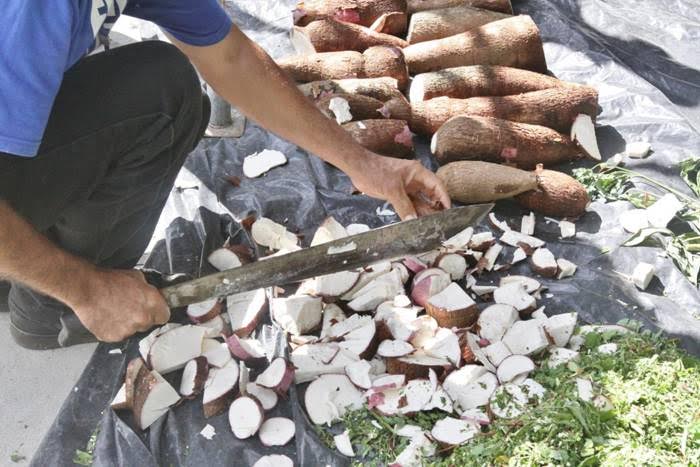
Cassava: a development alternative for small agribusiness
A meeting supported by IICA, the European Union and the Presidential Agency for International Cooperation of Colombia allowed technicians linked to the promotion of this crop marketing other ways that could strengthen markets.
Cassava flour, chips production, processing of the crop for feed and food and their use as raw materials were the topics that aroused most interest among participants.
San José, December 9, 2015 (IICA). Agricultural technicians from 12 countries in Latin America and the Caribbean (LAC) met in Costa Rica, new ways to add value to the production of cassava (Manihot esculenta) and modern processing technologies for this crop, allowing them to strengthen the industry , promote diversification of markets and improve the competitiveness of the chain.
Specialists managed to strengthen its links to form a network of innovation to facilitate the production, processing and marketing of cassava. They hope also to share experiences to groups of producers and other chain actors in their respective countries.
“Cassava is a strategic crop for the region, is a great alternative to ensure food and nutrition security and can be a good source of income; therefore, share knowledge within the framework of a hemispheric agenda is essential to overcome the limitations we face today, “said Deputy Director of the Inter-American Institute for Cooperation on Agriculture (IICA), Lloyd Day.

The meeting was attended by technicians from Costa Rica, El Salvador, Guatemala, Honduras, Nicaragua, Panama, Colombia, Suriname, Guyana, Granada, Barbados and Jamaica. It was organized by IICA, the European Union (EU), through the Regional Programme for Research and Innovation for Agricultural Value Chains (PRIICA) – and the Presidential Agency for International Cooperation of Colombia (APC-Colombia).
He also had the support of the National Institute for Agricultural Innovation and Technology Transfer (INTA) and the CLAYUCA Corporation.
Cassava flour, chips production, processing of the crop for feed and food and their use as raw materials were the topics that aroused most interest among participants.
According to the director of International Cooperation Offer APC Colombia, Enrique Maruri, supporting cassava has been a deeply felt demand for cooperation in your organization, as the crop is essential for food and nutrition security of the Caribbean nations .
“The first step in this process is to integrate with other regions have made significant progress in linking the Central, we want to consolidate these alliances in 2016 and that allow us to generate new knowledge extend beyond the region,” said the coordinator of PRIICA, Miguel Altamirano.
According to the participants of the event, foreground and the possibility of new experiences they enabled them to broaden their view on the subject.
Field trip
As part of the workshop, participants learned simple techniques and innovations to add value to cassava, and do not necessarily require large machinery.
With support from PRIICA and INTA of Costa Rica, a tour of the Diamonds (EELD) Experimental Station in Limon, Costa Rica, a processing cassava pilot plant is expected to generate and transfer technology in response to the needs organized producers in the Atlantic region and agro-ecological zones under similar conditions.
According to Patricia Bigby, Jamaica, although his country is planting cassava yet to explore in the field of scientific research. “We were not realizing all that can be done with cassava, now we know we can go further when you have the knowledge and support of national and international institutions, opens the way to empower people in the field, “he said.
Katrina Bradshaw, the Ministry of Agriculture of Barbados, said that the information he has collected during the five-day workshop will allow you to launch and promote the industry of cassava for human consumption in the country.
The EELD, 718 hectares dedicated to the production of bamboo forest protection, production of breeding stock of cattle and pigs, agricultural research in tropical fruit and roots, Musa, palm, palm. It also has a nursery for breeding of tropical fruit and crop genebanks and breeding laboratory in vitro.
In addition, during the last two days of the tour, participants visited the North Huetar region of the country, where they met the experience of PCI-Rojas processing plant micropropagation methods and found at the premises of the Technological Institute of Costa Rica
PRIICA IICA is a program implemented in coordination with INIA and funded by the European Union that aims to strengthen food and nutrition security of farmers, through the creation of partnerships between the public and private sector, knowledge management and research and innovation in cassava, potato, tomato and avocado in Central America and Panama.
Source: IICA