
García Tejerina highlights Salamaq as an example of the ministerial commitment by the indigenous cattle breeds
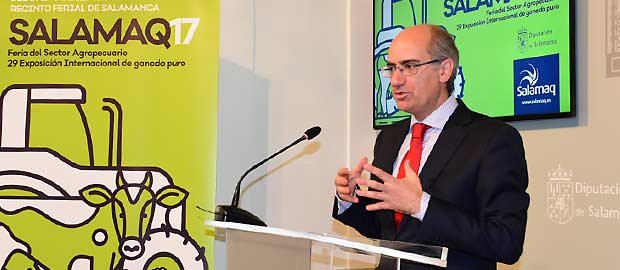
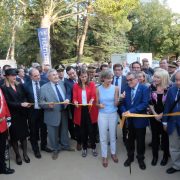
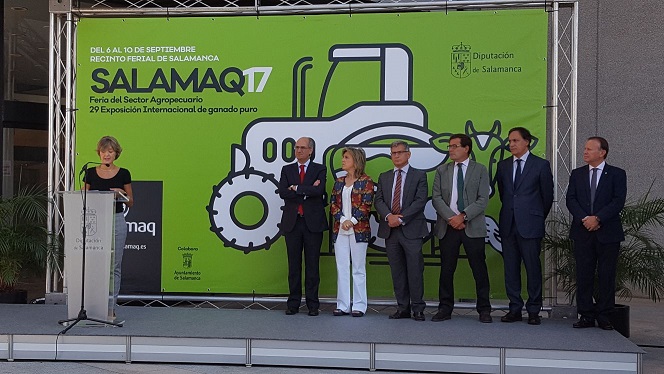
The Minister of Agriculture and Fisheries, Food and Environment, has highlighted the Salamaq Fair as a clear example of the ministerial commitment for the conservation and promotion of indigenous breeds, “an animal heritage of undoubted value”. For the Minister, the 1,400 specimens that participate in Salamaq 2017 show the genetic progress achieved by native Spanish breeds. García Tejerina, who made the remarks on the occasion of the inauguration on September 6th of Salamaq 2017, in which she was accompanied by the President of the Diputacion, the Delegate of the Government in Castilla y León, and the Secretary General of Agriculture and Food, referred to this event as “a symbol of what represents agriculture and livestock not in this land Castilian and Leon but in Spain”.
The minister recalled how the Ministry‘s commitment to livestock farming is also evident in the National Program for the Conservation, Improvement and Promotion of Livestock Breeds, which has a specific support line for associations of pure-bred cattle breeders and has established the “100% native race” logo. So far, there are already 38 breeds that have taken part in this initiative to obtain the hallmark.
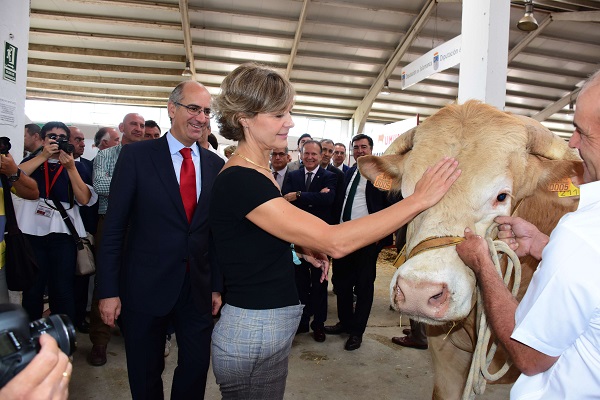 In the case of Salamanca, these breeds contribute greatly to the conservation of the pastures and the production of quality food, “another of the great attractions of Salamaq”, where they can taste the “exceptional products of this land of flavor” which houses 31 denominations of differentiated quality.
García Tejerina: “Salamaq17 exemplifies the strength of the Spanish agri-food sector”

The Minister underlined the commitment of this Fair for the modernization and competitiveness of the primary sector of our country, through internationalization, “with the participation of commercial and agri-food production companies that are at the head of the export in Spain,” and through innovation, “with the great success of having as strategic partner for that development the University of Salamanca and its research teams”.
The internationalization of Salamaq is evidenced by the presence of foreign representatives of the most important markets, as well as of Spanish agricultural companies, leaders in export
Javier Iglesias, president of the Diputación de Salamanca, who preceded the minister in the speeches of the opening ceremony, said: “we want Salamaq to be the meeting point between the primary sector and knowledge, through the teams of the University of Salamanca, IRNASA-CSIC, to lay the groundwork for collaborative work to improve the competitiveness and profitability of farms.
Diputación de Salamanca, University of Salamanca and Caja Rural de Salamanca have joined forces recently to sign an agreement that promotes research projects worth 150,000 euros
In his speech, Javier Iglesias thanked the confidence of commercial and livestock exhibitors and took advantage of the presence of the Minister of Agriculture to recognize the work of his Ministry and personal involvement in providing feasible solutions to the problems of the sector, “more in difficult years like this, with the consequences of drought. ” In that sense, he invited the Government of Spain and the Government of Castilla y León to continue their efforts to mitigate, as far as possible, the losses of the primary sector, through, for example, innovation as a tool which will help to better cope with adversity.
In this regard, the Minister, García Tejerina, pointed out that, although it is true that agricultural incomes are affected by adversities of various kinds, “Spain has policies so that income does not depend only on the climate: the Common Agricultural Policy and the Agricultural Insurance Policy”. She said that Spain’s insurance policy, as revealed at Monday’s meeting of EU agriculture ministers in Slovenia, “is well ahead of the rest of the EU, by giving farmers and ranchers the greater margin of coverage before the greater number of risks “.
Sources: Diputación de Salamanca and MAPAMA
YOU MIGHT ALSO LIKE: