
ASEDAS rewards as a best article of Distribution and Consumption a reflection on food waste
The Spanish Association of Distributors, and Supermarkets (ASEDAS) has advocated the expansion of corporate social responsibility policies towards society, with food surplus as an example. A message expressed on the occasion of the delivery of the III ASEDAS PRIZE to the best article of the magazine Distribution and Consumption, published by MERCASA, awarded to the professor of the University of Oviedo and founding member of the Alliance Against Hunger and Malnutrition, Antonio Blanco.
The awarded work “Reduction of food waste and social welfare: a possible relationship” analyzes the social implications of the food surplus and the need to address it from a triple perspective of economic, social and environmental sustainability
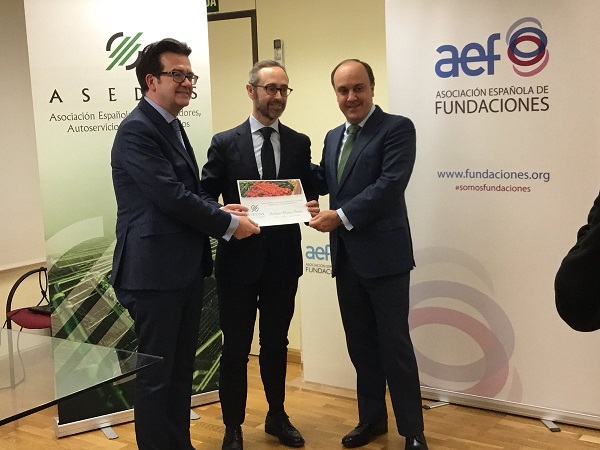 Ignacio García Magarzo, General Director of ASEDAS, recalled at the award ceremony that, according to data from the European Union, distribution is only responsible for 5 percent of the waste, compared to 11 for primary production, 12 the restoration, 19 of food processing and 53 of households.
With the actions aimed at reducing the food surplus as an example, ASEDAS argues that any action in this regard should be addressed from an approach that covers the entire food chain: from production to the final consumer – with special focus on the sectors that most they waste.

The involvement of the companies of ASEDAS, whose food surplus does not exceed 1 percent, is clear and addresses from citizen awareness campaigns, food donation and advanced management of the assortment to the demand for a profound structural change in food production: They change the mindset towards the idea of producing what is consumed instead of trying to sell what is produced.
The fight against food surplus is, in any case, only part of the commitment of the companies that make up the Association with the three pillars of Corporate Social Responsibility: economic, social and environmental responsibility, expressed in the Green Book of CSR of the European Commission.
The CSR actions carried out are very diverse and always take into account a proportional relationship between sustainability and economic development. In order for these to be efficient, they must be transparent and integrated into the lines of good governance and regulatory compliance policies; in addition, to be implemented in a non-burdensome way for the economic model of the companies, understood as an engine of creation of employment and wealth for society as a whole. The best example of this is the constant creation of employment in the sector: ASEDAS companies have registered during 2016 an increase of their staff of between 300 and 1,000 employees per company and their commitment to concepts such as the development of talent and Occupational Health & Safety.
About ASEDAS
The Spanish Association of Distributors and Supermarkets (ASEDAS) was founded at the end of the 90s and today is the first Spanish business organization of food distribution, with 18,000 stores that represent 67% of the commercial surface of food and employ 260,000 workers.
Source: ASEDAS
YOU MIGHT ALSO LIKE:
➡️ASEDAS predicts an increase in Christmas consumption between 3 and 5%