
Inicio > International > LATAM > Soybean cultivation in Mexico is reactivated

Soybean cultivation in Mexico is reactivated

The Secretariat of Agriculture, Livestock, Rural Development, Fisheries and Food (SAGARPA), through the National Institute of Forestry, Agriculture and Livestock (INIFAP) has projected planting of 45,000 hectares of soybeans in the Yaqui Valley, Sonora after it was allowed to sow the oil for more than 20 years.

By Redacción ECA

Share

[dkpdf-button]


The Secretariat of Agriculture, Livestock, Rural Development, Fisheries and Food (SAGARPA), through the National Institute of Forestry, Agriculture and Livestock (INIFAP) has projected planting of 45,000 hectares of soybeans in the Yaqui Valley, Sonora after it was allowed to sow the oil for more than 20 years.

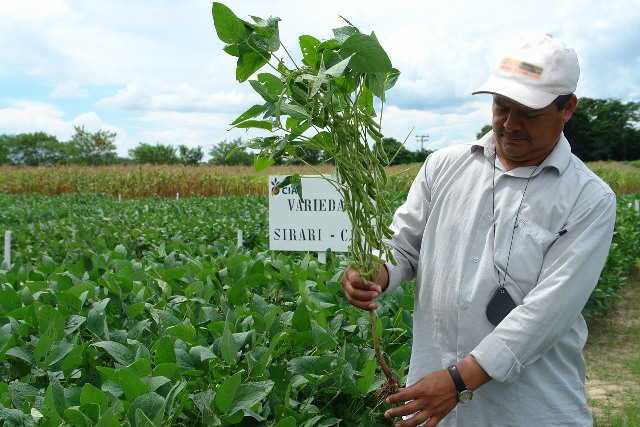
With the participation of producers, technicians, marketers and researchers Experimental Norman Borlaug (CENEB), INIFAP presented a technology for soybean cultivation in the said area with seed varieties that are resistant to the plague of whiteflies. The researcher Area Oilseed INIFAP, Lope Montoya Coronado, said the planting of the oil is planned for this summer and stressed the importance of producers to know the different varieties as Suaqui, Nainari, Cajeme and Guayparín, the latter of recent release.

This strategic project, he said, is to increase the economic movement not only in the Yaqui Valley, but throughout the northwestern part of the country, as this technology generated by INIFAP will spread to other regions, particularly in northern Sinaloa. It said that soy is left to plant in the state of Sonora in 1994 and began its revival in 2010 with 300 hectares, and to date its development and growth with the assistance of technology and innovation, as part of the new vision is driven increase production of oil in the country to reduce imports.

Among the comprehensive actions include the participation of the seed company, SEMAGRO and Proteínas y Oléicos, in order to analyze some aspects of planting dates and new whitefly-tolerant varieties.

Also studies for handling biological based products soaps and natural extracts, bio-insecticides, growth regulators pests, new agrochemicals, soil nutrition and others were performed. In the event held in the CENEB, researchers also participated Juan Manuel Cortes Jimenez, Xochitl Ochoa Espinoza and Nestor Aguilera.


Latest news

Related news

Olivares vivos

UE acknowledges LIFE Olivares Vivos as a benchmark for aligning agriculture and biodiversity

Coinciding with World Environment Day, the Olivares Vivos model is consolidating its position as a European example of how restoring biodiversity in agricultural landscapes can enhance the resilience and profitability of rural areas. The Special LIFE Award 2026 endorses a way of producing that brings life and future back to Mediterranean olive groves. ...
semillas

European agri‑food sector urges Parliament to approve the new NGT regulation without changes

More than thirty organisations from across the European agri‑food chain have called on the European Parliament to approve, without amendments, the new Regulation on plants obtained through new genomic techniques (NGTs), whose text was agreed during the December 2025 trilogue....
fruta de pepita

Interpera 2026: the future of the European pear industry comes together in Ferrara

Interpera, the international conference dedicated to the pear sector, will take place on 25 and 26 June in Ferrara, in the heart of Emilia‑Romagna, one of Europe’s leading pear‑producing regions....
AOVE

US market collapse forces spain to redefine its EVOO strategy

According to a report by the international consultancy Mainsource Ltd., the 44.7% drop in US imports of Spanish olive oil and the trade barriers derived from punitive tariffs are forcing the Spanish EVOO sector to rethink its supply chains and shift towards safer and more stable commercial corridors....