

I International Olivo Symposium in hedge, a direct look at the reality of this crop
The I International Symposium of the olive grove in hedge, Olint, recently celebrated by the University of Córdoba (UCO), Agromillora and Olint, technical magazine of Agromillora Iberia, represented a golden opportunity to obtain a more direct and close knowledge of the reality of this crop super-intensive. An event that attracted more than 600 professionals from the sector, who gathered in the Aula Magna of the Campus Rabanales of the UCO.
During the Symposium the market situation was analyzed and new characteristics and studies of the olive grove in the hedge were presented, as well as the new varieties adapted to this type of system
The opening session of the symposium was attended by the trade director of Agromillora Iberia, José Manuel Lacarte, the territorial delegate of Agriculture, Fisheries and Rural Development, Francisco Zurera Áragon, and the Vice-rector for Coordination and Infrastructure of the UCO, Antonio José Cubero Atienza.
The presentations began with the intervention of the general director of the Agromillora Group, Jordi Mateu, making a chronological tour of the evolution of the olive grove in hedge and presenting the future challenges that arise in said system of cultivation during the next years.

Next, the Director General of Elaia, Ramón Rivera, described the olive project that as a group are carrying out: 14,000 hectares and 4 mills distributed in different countries. An example of the current reality of the super-intensive olive grove and a clear commitment to innovation as a motor of growth.
In the second block of the morning, the Professor of the University of Bari, Salvatore Camposeo, presented the route of the olive grove throughout the Italian territory and the new varieties adapted to the crop, thanks to the cross between Spanish and Italian varieties.
Luis Rallo, Emeritus Professor at the University of Córdoba, spoke about the characteristics of the Sikitita olive variety, and the results of the genetic improvement program being carried out in collaboration with the UCO and the Institute of Agricultural Research and Training and Fisheries (IFAPA) of the Ministry of Agriculture, Fisheries and Rural Development of the Regional Government of Andalusia.
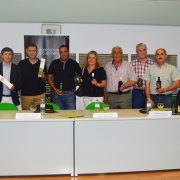
Towards the end of the morning, Maximiliano Arteaga, Director of Agro-Food Arch, explained first the necessary premises to properly manage the different varieties in the oil mill. And then a tasting of the olive varieties in the hedge: Arbequina, Arbosana, Oliana, Koroneki, Sikitita and Lecciana.
The afternoon block began with Ana María Morales Sillero, from the Department of Agroforestry Sciences, ETSIA, University of Seville, who announced the keys to the cultivation of the table olive.
Monji Msallem and Ajmi Larbi, Agronomists who are experts in olive cultivation and forestry in Tunisia, presented the results of the studies carried out over more than 15 years in different North African countries on high density olive plantations.
Following the afternoon lectures, the researcher of the Higher Council of Scientific Research (CSIC), Blanca Landa, analyzed the current situation of Xylella fastidiosa, and the measures that are being carried out to control it.
Before giving the floor to the round table, María Gómez, Agricultural Engineer and Professor Titula of the Universidad Politécnica de Madrid, presented the results of the design trials of the olive grove in hedge carried out since 2002.
To conclude the day, a round table was formed by Alvaro Olavarria, Managing Director of Óleoestepa, José María Falcao, Graduate in Agronomic Engineering by the Higher Institute of Agronomy of Portugal and Manuel Parras, Professor of Marketing and Market Research at the University Of Jaén, who gave their vision on the impact that superintensive olive grove has had on the olive sector.
Source: Agromillora Iberia S.L.