

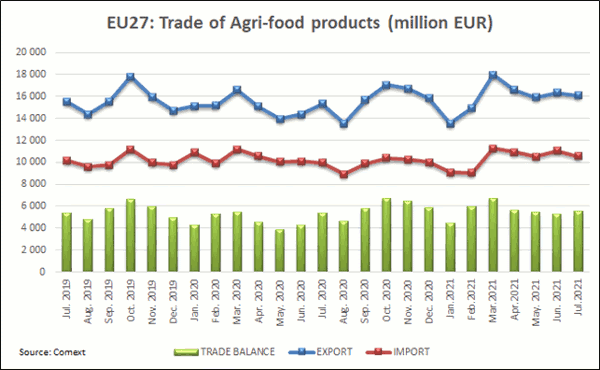
While the year began slowly, the total value of EU agri-food trade (exports plus imports) for January-July 2021 stood at €183.8 billion, a 3.2% increase on the corresponding period last .
While the year began slowly, the total value of EU agri-food trade (exports plus imports) for January-July 2021 stood at €183.8 billion, a 3.2% increase on the corresponding period last year. Exports were almost 6% higher at €111.4 billion, with imports dropping marginally by 0.2% to €72.4 billion. This reflects an overall agri-food trade surplus of €39 billion for the first seven months of the year, an increase of 18% compared to the same period in 2020.
The largest increase in exports was seen in those to the United States, the value of which grew by €1.6 billion, or 13%. This was primarily driven by wine, spirits and liqueurs, and chocolate and confectionary. There was also substantial growth in exports to China (€857 million higher), due to strong performances from spirits and liqueurs, coarse grains and wine. Additionally, the January-July period saw the value of exports increase significantly to Switzerland (up €450 million), Norway (up €352 million), South Korea (up €328 million) and Israel (up €257 million).
Continuing the trend observed throughout 2021, the biggest decline in agri-food exports was seen in those to the UK, down by €411 million. While this represents a 2% decline, it does illustrate a rebound in recent months following reduced export values in the beginning of the year. There were also notable decreases in the value of exports to Saudi Arabia (down €399 million), Algeria (€141 million), Hong Kong (down €110 million) and Kuwait (down €104 million).
The largest increase in agri-food imports was seen in products from Brazil, which grew by €849 million or 12% compared to the same period in 2020. Sizeable increases were also seen in imports from Australia (up €456 million), India (up €340 million), Serbia (up €248 million) and Argentina (up €189 million).
The overall decline in agri-food imports was mainly caused by a sharp fall in imports from the UK, down €2.4 billion or 29% compared to the first seven months of 2020. There were also significant decreases in imports from the United States (down €525 million), Ukraine (down €202 million), Vietnam (down €178 million) and Moldova (down €138 million).
Looking at specific product categories, the January-July period saw large growth in the export values of wine (up €2.2 billion) and spirits and liqueurs (up €1.1 billion), an increase of 30% and 32% respectively. Other significant export value increases were seen in rapeseed and sunflower oils (up €506 million), and chocolate and confectionary (€505 million). There were, however, substantial falls in exports of wheat (down €1.3 billion) and infant food (down €718 million), with more minor but notable reductions also recorded for exports of butter (down €163 million), vegetables (down €161 million), and milk powders and whey (down €100 million).
The biggest increases in the value of imports were seen in soya beans (up €929 million), oilcakes (up €901 million), fatty acids and waxes (up €299 million). Meanwhile, the highest decreases in import values were recorded in tropical fruit, nuts and spices (down €814 million), unroasted coffee and tea (down €230 million), and citrus fruits (down €181 million).


