

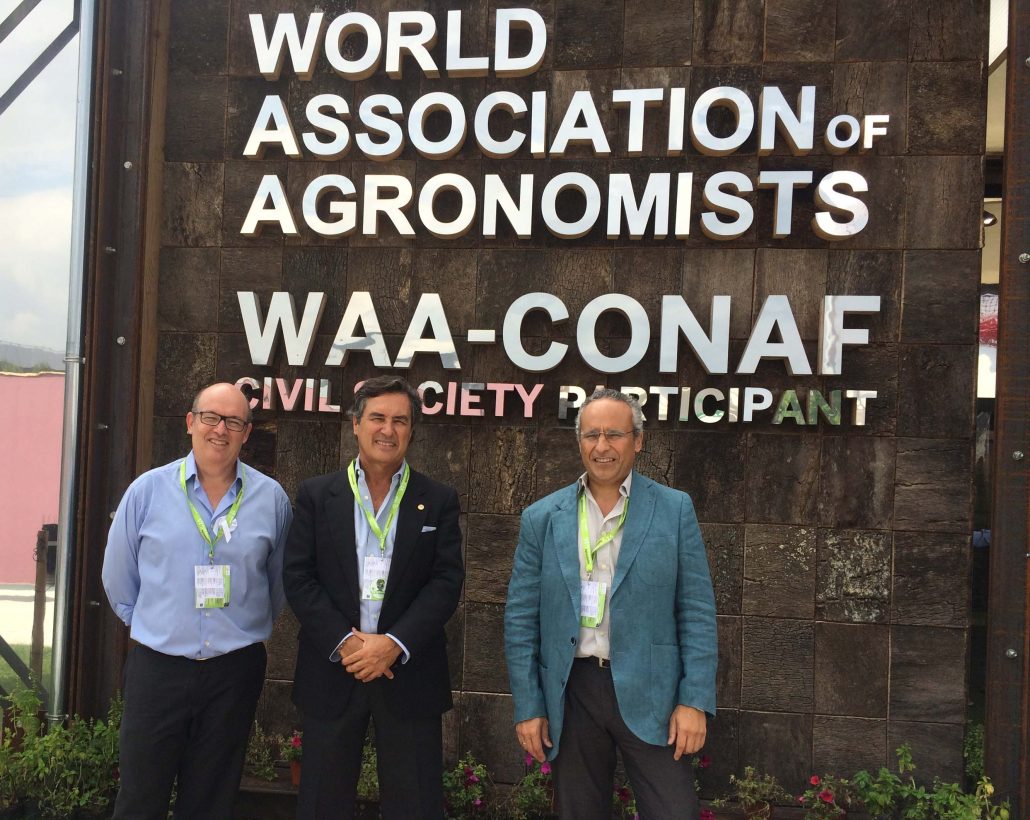
Agricultural engineers together to the challenge of feeding the planet
In the Sixth World Congress of Agricultural Engineers, held at the Expo of Milan, monograph on the challenge of food has been prepared the Charter of the agronomist includes ten principles of the definition of a technical strategy and environmental sustainability for the entire planet and especially for developing areas.
The population in the world is estimated at 7,000 million and is expected that by 2050 more than 9,000 million people inhabit the Earth. Growth has been significant in recent years, taking into account that in 1800 was 1,000 million; in 1950, it reached 2,300 million and in 1999 exceeded 6,000 million.
These data represent a global population explosion unprecedented in history and presents significant challenges. To study specific measures in food, production and distribution as a key activity in sustaining this population, we celebrated the VI World Congress Expo in Milan, which brought together 800 agricultural engineers from different countries, have participated in the 48 tables organized labor, whose findings have been enshrined in the Universal Charter of the agronomist a document that defines the ethical principles for professional development and whose entire document attached.
The Universal Charter of the agronomist stresses their responsibility in the process, for the important role you have in this task, as designer foods, ensuring optimization of production processes along the entire food chain and promoting healthy eating, healthy and to meet nutrient needs and to reduce food losses and waste. Keep in mind that each year is lost or about a third of the food produced worldwide for human consumption, 1,300 million tons were discarded, according to the FAO (United Nations Food and Agriculture ).

They are also committed to safeguarding the sustainability in all its aspects as a professional ethical duty. And it recognizes that it can not accept a misuse of resources that are scarce and in many sensitive cases.
The agronomist guarantee the safe keeping of biodiversity and the protection and sustainable management of soil to maintain its fertility and prevent spoilage, as it is an essential element for life.
They must also protect the landscape, the value consists of the “territory-culture” through proper planning and territorial projection, ensuring rural development, namely the maintenance and growth of local socio-economic systems.
In addition, it calls for the social use of genetics. As enshrined in the Charter, the genetic heritage of living species belongs to all and should serve the good of humanity.
Also ensures a social use of technology and innovative practices with the aim of which is not used to the detriment of the weakest, or to reduce the ability to exercise their fundamental rights.
The professionals assigned to the Charter also subscribe intellectual independence and professional autonomy, knowledge through training and esprit de corps.
These data represent a global population explosion unprecedented in history and presents significant challenges. To study specific measures in food, production and distribution as a key activity in sustaining population has held that the Sixth World Congress.
Jerónimo Cejudo, dean of the College of Agronomists of Andalusia and Vice President of the National Association of Agricultural Engineers of Spain (ANIA), has worked on the development of the Universal Charter of the agronomist. Cejudo explained that “the Andalusian and Spanish engineers and technical specialists in food production have much to contribute in a global strategy to the challenge of feeding the world’s population and prevent hunger and malnutrition affecting nearly 1,000 million people , according to FAO. The future, to safeguard resources, preserve the territories and meet our needs, through the use of technology. The Earth is our only home and yet, as has been raised in Milan, is the global farm that nurture us. We must be increasingly careful and we should apply all our knowledge to it. ”
Andalusian agronomists have provided conclusions as smart proposals for the rural world by the managing partner of Rurápolis, Miguel Angel Molinero, professional responsibility by Diego Diaz de la Serna, technical secretary of the College, or the integration of landscape and Fatima agriculture by Ruiz Castillo, member of the College.
Source: COIAA